
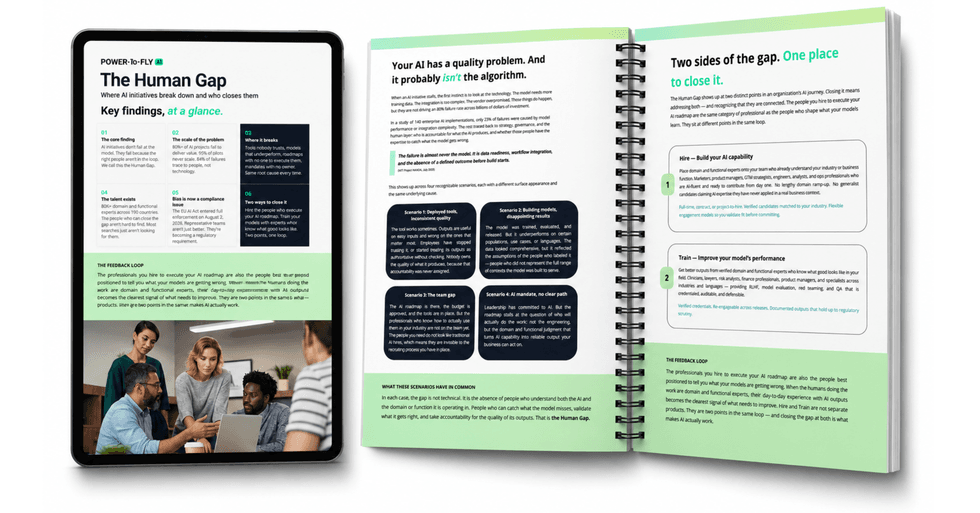
You've probably heard AI failures pinned on the model. It hallucinated, it missed context, it just wasn't ready. That's a reasonable place to start looking. But 84% of AI program failures trace back to people and leadership gaps, and the model is rarely where the real problem lives. The Human Gap 2026 Benchmark Report breaks down exactly where that gap shows up, from missing human-in-the-loop oversight to accountability nobody actually owns, and what closes it before a project stalls.
Where AI initiatives break down
Here's what 2026's data actually shows about where AI initiatives break down.
80%
of AI projects fail to deliver intended business value
95%
of generative AI pilots never scale beyond proof of concept
84%
of failures trace back to people and leadership, not technology
The full report breaks down what's driving each number, and what closes the gap.
What the Human Gap actually is
When we talk to clients about the Human Gap, we describe it as a shortage of domain and functional experts who know what good looks like, paired with AI-fluent people who can put models to use. If your team hired for AI fluency first and expected domain judgment to develop on the job, that's usually where the gap starts to show.
In our experience, this starts as a governance question long before it ever becomes a technical one. Someone needs to own the judgment layer between what a model produces and what your business does with it. When that ownership sits with someone who doesn't have the domain background to catch what's wrong, the failure surfaces months later in production instead of in testing, which is exactly the gap this report is built to close.
The report walks through where this breaks down across three stages: accountability, training data, and human-in-the-loop review, with real findings on what's working, what isn't, and what actually closes the gap.
Download the 2026 benchmark report
Frequently asked questions
What is the Human Gap?
The Human Gap is the shortage of people who can make AI actually work in your business: domain and functional experts who know what a good outcome looks like, paired with AI-fluent professionals who can put models to use. This report tracks where that shortage shows up across the AI buyer journey, and what closes it.
Why do most AI implementations fail?
Most AI implementations fail because nobody owns the judgment calls your model can't make on its own. 84% of AI program failures trace back to people and leadership gaps, most often unclear accountability, narrow training data, or missing human-in-the-loop review before launch.
Is AI transformation a technology problem or a governance problem?
It's rarely the technology. AI transformation stalls when no one owns the judgment layer between what a model produces and what your business does with it. Assign that ownership early, and technical problems tend to stay technical instead of turning into stalled mandates.
What does "human in the loop" mean?
Human in the loop means a person with the right domain background reviews and validates what an AI model produces before it reaches a real decision or a real customer. In your organization, that person isn't there to rubber-stamp outputs. They're catching the cases where the model is confident and wrong, which is exactly the judgment a model can't produce on its own.
