Updated August 29, 2026 to reflect the latest information.
TL;DR: AI implementation failure is rarely a technology problem. Eighty percent of AI projects fail to deliver business value, and 95% of pilots never scale past testing, according to research from RAND Corporation and MIT. The real driver behind most enterprise AI failure rate data is the human layer around the model: who owns it, who evaluates it, and who was in the room when it was built. Here's a breakdown of the four failure modes behind most AI implementation failures, and what to do about each one.
The scale of enterprise AI failure
If your AI implementation has hit a wall any time recently, you've probably already run through the usual suspects: not enough training data or a vendor who oversold the tool. Those things do happen. They just don't explain why the failure rate for corporate AI implementations is this high.
RAND Corporation's 2025 research on why AI projects fail found that more than 80% of AI initiatives fail to deliver their intended business value, roughly twice the failure rate of conventional IT projects. MIT's Project NANDA went further in its July 2025 GenAI Divide report, showing that 95% of generative AI pilots never scale past proof of concept. A clear pattern has emerged that connects AI failure to the people responsible for building, evaluating, and owning it, rather than the technology itself.
PowerToFly's Human Gap 2026 Benchmark Report puts a number on that pattern directly: 84% of AI program failures trace back to people and leadership issues, not technology. The technology usually works fine; the problem lives in everything that happens (or doesn't) around it.
If your program isn't delivering the way it should, this distinction matters more than it might seem. If the failure is a model problem, the fix is more engineering. If it's a people problem, no amount of engineering is going to solve it. Diagnosing the right cause early can keep you from spending months (and precious budget) chasing a solution that wasn't going to work in the first place.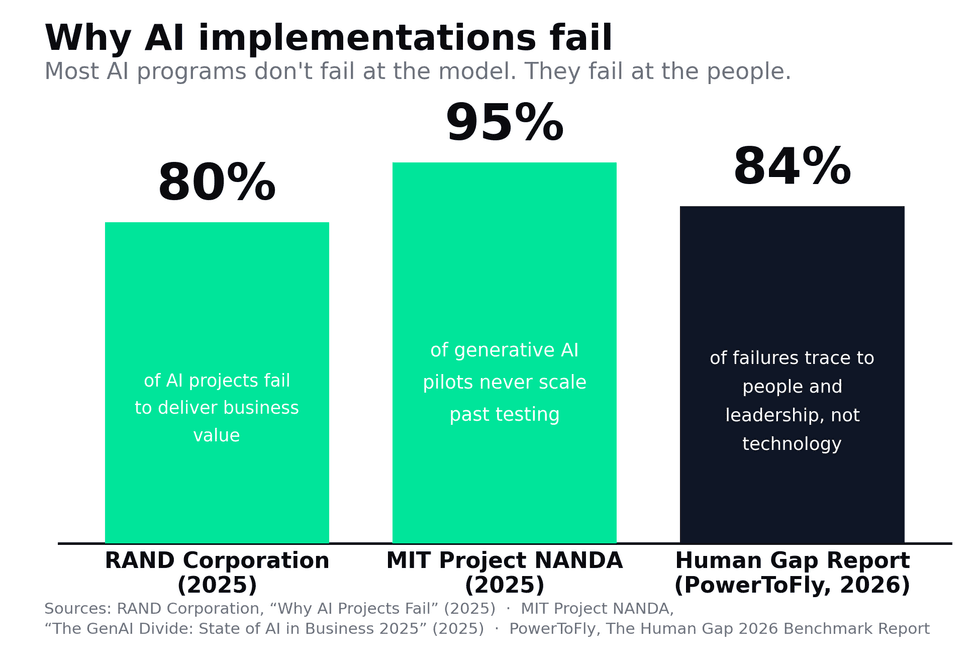
The model that worked in the demo
We've seen this exact pattern play out with several of our clients over the past year. A mid-size healthcare company built an internal tool to summarize patient intake forms. It performed beautifully in testing. And then it went live.
Within weeks, the tool started missing context-specific risk factors, the kind of detail a nurse would catch without thinking twice. The model itself wasn’t broken. The problem traced back to the team of trainers that had never worked a clinical floor. Their generalist-level of knowledge made it so they weren’t able to catch these gaps before launch. A nurse flagged it nearly three weeks after the tool went live, once actual patients were already in the system.
This is a perfect example of what training data that reflects a small room looks like in practice. The data looked comprehensive in testing, but it wasn't comprehensive enough for the population the tool actually served.
Four failure modes behind most AI implementation failures
The Human Gap report identifies four recurring patterns behind enterprise AI implementation failure.They might not be obvious at first glance. Instead, they show up slowly: an unreviewed output here, an unfilled role there, a compliance question that keeps getting deferred.
Accountability without expertise
This is what accountability without expertise looks like: AI output quality gets assigned to a team that doesn't have the domain knowledge to evaluate it. Engineers own the model while operations owns the workflow, and nobody owns the judgment layer in between.
The good news is, the solution doesn't require a large team. It requires someone on your team with the domain or functional expertise and the authority to validate, correct, and escalate AI outputs.
Fixing ownership only helps if the model itself was built on the right foundation to begin with.
Training data that reflects a narrow room
This is the failure mode behind the healthcare example above. When a team builds a model on data that reflects only its own backgrounds and assumptions, that data can look complete right up until the model meets a population, use case, or language outside that experience. The gaps don't usually show up in the testing stage in this context. They show up in production on real people.
Building annotation and evaluation cohorts that reflect the range of people your model will actually serve, from the start of your data pipeline rather than after deployment, is what fixes this.
Even solid data and clear ownership won't help if you can't find the right people to do the work in the first place.
The wrong search for the right people
Your job posting asks for an AI engineer with 10 years of experience. What the role actually needs is a domain expert with two years of AI practice. This causes the search to run for months and ultimately fail, not because the talent doesn't exist, but because your recruiting process was never built to find it.
Separate the search for technical AI capability from the search for domain and functional AI talent, and this gets a lot easier. They're different pools, reached through different channels, and often available faster than you'd expect.
And once you've hired well, what happens next (how that work gets reviewed and scaled) is just as important.
Scale without accountability
Hiring well doesn't finish the job. Anonymous annotation platforms can produce data quickly for your team, but they can't produce the documented, defensible record of who did the work and under what oversight, which is what regulators and enterprise customers increasingly require. When a regulator or customer asks who shaped your model, "unknown workers" isn't an answer that holds up anymore.
Work with credentialed, re-engageable domain and functional experts whose outputs are documented and auditable, and that answer changes. Volume still matters. So does knowing who produced your data and whether they were qualified to do it.
Bias and accountability are now compliance questions
AI bias used to get treated mostly as an ethics conversation, which is still valid and relevant. But if you're building tools that serve real customers, it also becomes a regulatory and financial issue for you.
The EU AI Act's high-risk obligations were originally set to take effect August 2, 2026, but the Digital Omnibus on AI pushed that deadline to December 2, 2027 for standalone systems like these. High-risk systems, including those used in healthcare, hiring, and credit assessment, will need to be trained on sufficiently representative data and stay auditable throughout their lifecycle once that deadline lands, and building toward it now beats scrambling in 2027. Similar frameworks are advancing in the US and elsewhere. For the current timeline in full, see PowerToFly's guide to the EU AI Act.
Representative teams are no longer simply a quality advantage. Increasingly, they're what lets you answer a regulator's questions about how your model was built.
Closing the gap in your own AI program
All of this talk about failure may feel a bit negative or overwhelming. But, there’s a silver lining in all of this. None of the four failure modes above requires starting over. Each one has a specific, addressable fix: name an owner, diversify who evaluates your model, split the technical search from the domain search, and verify who's doing the work.
The common thread is a human in the loop: someone with real domain or functional expertise between the AI output and whatever happens next. The problem is, most teams don't think to hire for this type of role on purpose, and they don’t notice it’s missing until after something has already gone wrong.
There are two ways to close this gap. One is who you hire to execute your AI roadmap: product managers, analysts, and specialists who already understand your industry and can contribute from day one. The other is who trains and evaluates your models: domain experts who know what a correct output actually looks like in your field, beyond what merely looks plausible. They're connected. The people best positioned to build your AI program are often the same people best positioned to tell you when it's getting something wrong.
If your team is in the middle of an AI initiative that isn't working the way it should, take a look at the people behind your AI models instead of jumping to the technology.
FAQ
Why do AI projects fail?
Most AI projects fail because of people and leadership issues, rather than the technology itself. Common culprits include unclear ownership of AI output quality, training data built by a team that doesn't reflect the population your AI serves, and hiring searches aimed at the wrong kind of talent.
What is the enterprise AI failure rate?
Research from RAND Corporation found that more than 80% of AI projects fail to deliver their intended business value. MIT's Project NANDA found that 95% of generative AI pilots never scale past proof of concept.
How do you fix a failing AI implementation?
Start by identifying which of the four failure modes applies to your program: unclear accountability, narrow training data, the wrong hiring search, or a lack of clear records showing who produced your training data and under what oversight. Each has a specific fix, and most don't require rebuilding your initiative from scratch.
What is the Human Gap?
The Human Gap is the term PowerToFly uses to describe the shortage of domain and functional experts positioned to build, evaluate, and take accountability for AI systems. It shows up both in who you hire to execute your AI roadmap and in who trains your models.
Is AI bias a compliance risk now?
Yes, even though the strictest deadline moved. The EU AI Act's high-risk obligations, originally due August 2, 2026, were deferred to December 2, 2027 under the Digital Omnibus on AI. That's runway to prepare, not a reason to wait: the requirement to train on representative data and stay auditable is still coming, and similar regulatory momentum is building in the US and other regions right now.
Ready to close the gap in your own AI program?
Download the Human Gap 2026 Benchmark Report for the full data, or talk to PowerToFly about closing the human layer gap on your team.
- 15Five
- 1Password
- 2U, Inc.
- 33Across
- 7Park Data, Inc.
- AAA
- Abbvie
- Accenture
- ActZero.ai
- Adidas
- Adobe Systems Incorporated
- ADP
- AdRoll
- Aetna
- Aetna, a CVS Health Company
- Afterpay
- Airkit
- AlertMedia
- Alloy
- Amazon
- AMC Networks
- American Express Company
- Andela
- Apartment Therapy Media
- Apple
- AppNexus, a Xandr Company
- Arch Insurance
- Arize AI
- Arrow Electronics
- Art Processors
- Asana
- Ask Rachel
- ASM
- Atlassian
- Attune Insurance Services, LLC
- Audible
- Aurora Solar
- Autodesk
- Automattic
- Avaaz
- Avanade
- Avery Dennison
- Back Market
- Bank of America
- Better Companies
- Better Mortgage
- BioRender
- Black Community
- BlackRock
- Blockstack
- Blog
- Bloomberg LP
- Blue Cross and Blue Shield North Carolina
- Bluecore Inc
- Boeing
- BounceX
- Bounteous
- Braintree
- Bridgewater Associates
- Bristol Myers Squibb
- Buffer
- Bumble
- Buzzfeed
- Cable News Network, Inc.
- CallRail
- Calm
- Camunda
- Capco
- Capital One
- Carbon Direct
- CardFlight
- Career and Interview Tips
- CarGurus
- Carvana
- Casper
- CB Insights
- CDW
- Celonis
- CenturyLink Inc.
- Chainalysis Inc.
- charity: water
- Checkr
- CHG Healthcare
- Chingari
- Chubbies
- Ciena
- CircleCI
- Cisco Meraki
- Citi
- Clarus Commerce
- Clarvida
- CLEAR
- CloudBees, Inc.
- Cloudflare
- CLS
- Clyde
- Co-Op
- Cockroach Labs
- Collective Insights
- Collins Aerospace
- Comlinkdata
- Commvault
- Companies That Care
- Compass
- Condé Nast
- Contentful
- Contrast Security
- Convoy
- Costar Group
- CoverMyMeds
- Cribl
- Crowdstreet
- Cruise
- CSL
- CU Direct
- Culture Amp
- Cummins
- Dassault Systemes
- Datadog
- Def Method
- Deliveroo
- Delivery Hero
- Dell Technologies
- Deloitte
- Delphix
- Deutsche Bank AG
- DigitalOcean
- Dishcraft Robotics
- Diversity Reboot Newsletter
- Diversity Reboot Summit 2020 Product Expo
- Diversity Reboot Summit 2021 Virtual Booths
- Diversity Reboot Summit Speakers
- DocuSign
- Dow Jones Company
- DreamSpring
- Dropbox
- Duck Creek Technologies
- DuckDuckGo
- dv01
- Dynatrace
- EDO, Inc
- Elastic
- Enbridge
- Energy Impact Partners
- EnerSys
- Equinix
- Esri
- Expedia Group
- Fair
- FairFrame
- Featured Post
- Featured Talks
- Fidelity
- Flatiron Health Inc
- Flexport, Inc.
- Flocabulary
- Flywheel
- Folsom Labs
- For Employers
- Forbes Media
- Forward
- Freddie Mac
- FTI Consulting
- fuboTV
- G2i
- Gainsight, Inc.
- Gamechanger
- Gantry
- General Assembly
- GitLab
- GoEuro Travel GmbH
- Goldman Sachs
- Good Money
- Google Inc
- GoTo
- Greenhouse Software
- Guru
- Halliburton
- HashiCorp
- Headway
- HealthEdge
- Healthfirst Inc
- Hearst
- Helix
- Helm
- Help Scout
- Hitachi Energy
- Homecare Homebase
- Hopin LTD
- Hult EF
- Hyperloop
- impact-com
- Imply
- In Person Events
- InDebted
- Indeed
- insightsoftware
- Intent
- Intuit
- Intuitive
- Invesco
- Jama Software
- Jamf
- Jemstep
- Jobs
- Johnson & Johnson
- Join Now
- Joor Inc
- Juniper Networks, Inc.
- Justworks
- JW PLAYER
- Kami
- Karat
- Kargo
- Katharine Zaleski's Blog
- Kensho Technologies
- KeyCaliber
- Kin + Carta
- Kinaxis
- Kinesso
- Kiva
- Knotel, Inc.
- L3 Technologies
- Lattice
- LendingClub
- LetsGetChecked
- Liberty Hill Foundation
- Light & Wonder
- LiveSafe
- Lockheed Martin
- Log In
- Logickull
- Logikcull
- Logitech
- Logiworks
- Lyft
- Managed By Q Inc
- Manifold.co
- Marqeta
- Mastercard
- Match Group
- Match.com
- McMaster-Carr Supply
- Meredith Corporation
- Meta
- Metromile, Inc.
- Microsoft Corporation
- Millennium Management
- Mindbody
- MiQ
- Mission
- Mitsubishi Power
- MongoDB
- Moody's
- Moov Financial
- Morgan Stanley
- Morning Consult
- Motivate
- Munich RE
- MURAL
- MyFitnessPal
- Myriad360
- Nacelle
- nascar
- National Geospatial-Intelligence Agency
- National Security Agency (NSA)
- Nba
- NBCUniversal
- Nestlé
- Netskope
- New Relic
- New York Life Insurance Company
- Nextdoor.com, Inc.
- Nike Inc
- Nokia
- Noodle
- Northrop Grumman
- Novelis Inc.
- Nowsta
- OfferUp
- OkCupid
- Okta, Inc.
- Olive
- One Medical
- OneLogin, Inc.
- OpenTable
- Optoro
- ORTEC
- Oscar Insurance Corp
- OUTFRONT Media Inc.
- Pacific Western Bank
- Packet
- PagerDuty
- Partnership on AI to Benefit People and Society
- Pax Labs Inc
- Pax8
- Paylocity
- Paypal
- Peloton
- PepsiCo
- Philo
- Pitney Bowes Inc.
- PlayStation
- Plectica
- Plenty Of Fish
- Plex
- Pluralsight
- Polis, Inc.
- popular
- PowerToFly Hires
- PowerToFly VIP
- Press
- Previous Event
- Priceline
- Primer
- Procore Technologies Inc
- Product Updates
- Projector
- PromptWorks
- PwC
- pymetrics
- Qualtrics
- Quicken Loans
- Quip
- Random
- RapidScale
- RapidSOS
- Raytheon Technologies
- Realtor.com
- RebelMouse
- RebelMouse Test
- Reddit, Inc.
- Reference Point
- Relativity
- Remote
- Remote Hiring
- Rest Of World
- Ribbon
- Riot Games Inc
- Rockstar Games
- Rover
- RTB House
- S&P Global Inc
- Samsara
- Sapient Consulting
- Sauce Labs
- Schneider Electric
- ScienceLogic
- Scout RFP
- SeatGeek
- SendGrid
- Sentropy Technologies
- Sephora
- ServiceNow
- SevenFifty
- Shield AI
- Shogun
- Shopify Inc.
- Shure
- Siemens
- Skedulo
- Slack Technologies, LLC, a Salesforce company
- Smartsheet Inc.
- Snap Inc.
- SoftwareOne
- Solo Brands
- Solstice
- Sonos
- SoundCloud Inc.
- Spectrum
- Splunk
- Spoiler Alert
- Spot AI
- Spotify
- Stack Overflow
- Stash
- State Listings Inc.
- Stem Disintermedia
- StockX LLC
- Stripe
- Stryker
- SumOfUs
- Sun Life US
- Surescripts LLC
- SV Academy
- Symantec
- Synchrony
- T Rowe Price
- Tackle.io
- Talent Sourcing Trends
- Tandem Diabetes
- Teachers Pay Teachers
- Tech Talk
- Tenable
- Tesla
- Testimonials
- Textio
- Thales Usa Inc.
- The Recycling Partnership
- The Walt Disney Company
- Thomson Reuters
- Thornburg Investment Management
- Thoughtbot
- Thrive Global
- Thumbtack
- Time Inc
- Tinder
- Tiny Mile
- Tiugo Technologies
- TodayTix
- Trail of Bits
- TrussWorks, Inc
- TURO
- Uber
- Ubiquity6
- Udemy
- UiPath, Inc.
- UKG
- United Technologies
- UnitedHealth Group
- Unstoppable Domains
- Upcoming Event
- uShip, Inc.
- Vanguard
- varicent
- Veracode
- Verisign
- Verizon Communications
- Viacom Inc.
- Viasat
- VICE Media Group
- VideoAmp
- Virtu Financial
- Visa
- Vizient
- Vouch Insurance
- Vrbo
- VTS
- Waters Corporation
- Wayfair Inc.
- Webinars
- Wells Fargo Company
- WeWork
- Wolters Kluwer
- Women at Work
- Work & Co
- Work-Life Integration
- Workiva
- WW (Formerly Weight Watchers)
- Yelp Inc.
- YouCanBook.me
- Yougov
- Zapier Inc
- Zendesk, Inc.
- Zeta Global
- Zillow
- Zoom
- ZwillGen
- Zynga