This article was updated on May 23, 2026, to reflect the latest information.
TL;DR: A great onboarding checklist helps new hires feel welcomed, prepared, and ready to contribute from day one. This guide walks you through every stage — pre-boarding, day one, week one, and ongoing support — with practical, inclusive steps that boost retention and productivity. Research shows organizations with a strong onboarding process improve new hire retention by 82% and productivity by over 70%. Here's how to build one that delivers.
Onboarding is more than an HR task. It's the first major step in setting new employees up for long-term success. When done well, an inclusive onboarding checklist fosters a welcoming atmosphere that increases morale and retention.
The data backs this up. According to Brandon Hall Group's onboarding research, organizations with a strong onboarding process improve new hire retention by 82% and productivity by over 70%. Yet Gallup finds that only 12% of employees strongly agree their organization does a great job onboarding new people. That gap is a real opportunity.
An efficient onboarding checklist helps close it — ensuring nothing critical gets missed and every new recruit feels encouraged, valued, and ready to contribute from the start.
Ready? Here's how to build one.
Onboarding checklist template
Great news — to make your onboarding process as effective and inclusive as possible, we've already prepared a detailed onboarding checklist that covers everything from pre-onboarding to ongoing support. Download it, copy it, and follow the steps.
📝 Download our free onboarding checklist
Now let's walk through how to implement each stage, step by step.
Pre-onboarding checklist (before day one)
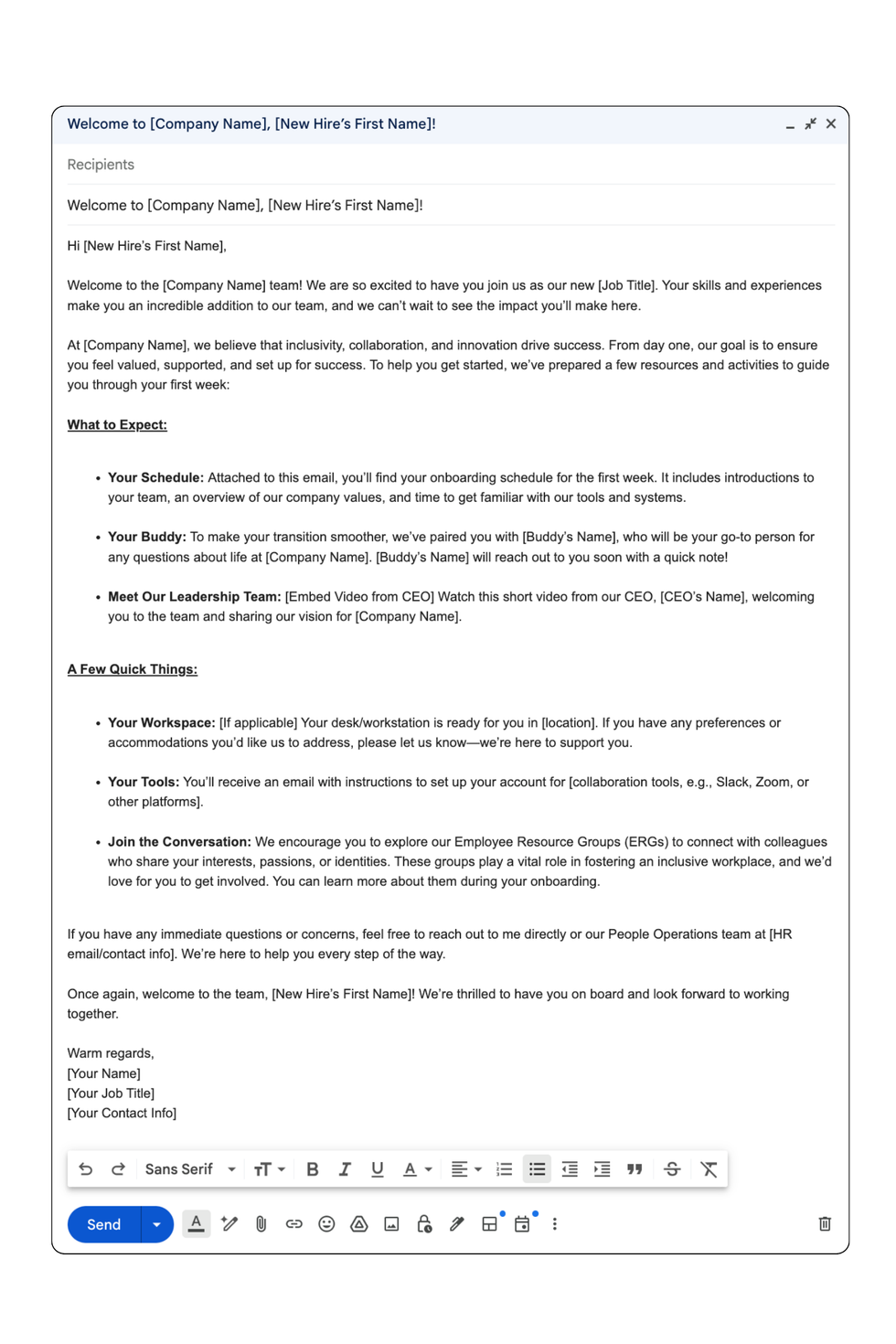
Effective onboarding starts before the first day. Pre-onboarding activities help new hires arrive feeling prepared and genuinely excited to join your team. While pre-boarding looks different for every organization, here are the core steps to include.
1. Prepare paperwork and resources
Ensure all documents are digitally accessible. Use digital forms that meet ADA standards so new hires can complete paperwork before their first day. This saves time, builds early confidence, and helps them start learning the company culture before they walk in the door.
Provide options for preferred names and pronouns on onboarding materials. Incorporating a new team member's preferred name and pronouns into onboarding documentation is a simple, respectful way to signal that inclusion is a priority — not an afterthought.
2. Personalize the welcome
Send a personalized welcome email. Before the new hire's first day, send a detailed email laying out their first week's schedule. Include team introductions, useful resources, and a summary of their responsibilities. For in-person roles, add parking information and a few helpful office tips. For remote hires, be specific: explain what tech to expect, how they'll log in, and who to contact if something goes wrong on day one.
Include a quick video or note from the manager or CEO. A personal touch goes a long way. A short video or note expressing genuine excitement about the new hire joining helps them feel like they belong before they've even started.
3. Assign a welcome buddy
A welcome buddy — essentially a peer mentor — is someone who can support the new hire throughout their first few weeks. This is especially effective when the buddy comes from an underrepresented group, because it reinforces that inclusion is woven into the culture, not just stated in a values doc.
A welcome buddy helps with:
- Navigating business tools and systems
- Answering questions about company culture and daily routines
- Providing emotional support during the transition
Day one checklist
The first-day experience matters. Here's how to make it inviting and smooth.
1. Start with a warm welcome
One of the most important things you can do on day one is create a welcoming environment right away. Whether your team is hybrid, in-office, or fully remote, a team introduction meeting lets everyone share a quick "about me." It reduces early jitters, builds immediate connection, and helps the new hire start learning who their colleagues are and what they do. This kind of low-pressure kickoff sets the tone for everything that follows.
2. Walk through core values and mission
Spend time walking the new hire through the company's core values and mission — not just handing them a handbook. Help them see how their role connects to the organization's broader goals. Employees who understand the company's mission from day one feel more engaged and more motivated to contribute. Covering values also sets clear expectations for behavior and relationships from the start.
3. Address accessibility and accommodations
Make it easy for the new hire to request any adjustments they may need, whether for physical accommodations, mental health, or other workplace needs. Spelling out the process clearly — and creating a safe space to ask — tells the new employee that their well-being is a genuine priority. This builds trust quickly and lets them focus on their role rather than worrying about whether they'll be supported.
Read this next: 7 easy ways to improve accessibility in the workplace
Week one checklist
After a strong first day, the focus shifts to building clear expectations and increasing engagement. Getting your new team member settled into a routine with concrete goals and a warm environment is key to long-term productivity and a healthy workplace culture.
1. Set clear expectations with a role-specific onboarding plan
Create a structured onboarding plan. Outline major objectives and milestones for the new hire's first 30, 60, and 90 days. Include performance benchmarks and success criteria so they know exactly what to aim for. If it's possible, build in early career development conversations — showing a new employee what their path forward looks like is a powerful way to build commitment and motivation from the start.
Read this next: Goal setting for employees | Step-by-step guide
2. Schedule 1:1 check-ins
Set up weekly or biweekly 1:1 check-ins between the new hire and their direct manager. These meetings demonstrate that the new hire's progress matters and that their questions will be answered — not ignored. Regular check-ins also give managers an early signal if something isn't working, before it becomes a retention problem.
3. Invite new team members to employee resource groups (ERGs)
Introduce new hires to relevant Employee Resource Groups (ERGs). These are one of the most effective ways to promote inclusion and help people find community at work. If your company doesn't yet have ERGs, look for other ways to integrate new employees — cross-department projects or informal team activities can serve a similar purpose.
Ongoing support checklist
Effective onboarding doesn't stop after week one. Continuous attention and investment help new hires stay engaged, feel valued, and ultimately succeed.
1. Create continuous learning opportunities
Give new hires access to learning and development resources — both internal and external — that help them grow in their role and advance within the organization. Consider programming like SkillCrush to support their continued development beyond the initial onboarding window.
Read this next: How to craft the perfect employee development plan
2. Create a survey for new hires
The best source of feedback on your onboarding process is the people who just went through it. Invite new employees to share their honest thoughts about their onboarding experience. That feedback helps you improve the process for future hires, and it signals to current employees that their voice is heard.
3. Celebrate early wins and acknowledge contributions
Recognize new employees' accomplishments early and often, big or small. Early recognition improves morale, builds team connection, and makes a real difference in how engaged someone feels in their first weeks on the job.
Watch this next: The role recognition plays in employee retention
Remote onboarding
Many employees now begin their roles remotely, and a thoughtful remote onboarding process may matter even more than an in-person one. Without the natural social fabric of a shared office, it takes more intentional effort to help remote hires feel like part of the team.
For specific ideas on making remote onboarding more inclusive and effective, check out 7 steps to inclusive remote onboarding.Managing a successful onboarding checklist
A well-executed onboarding checklist does more than check boxes. It builds the foundation for how an employee experiences your company — and whether they stay.
According to Gallup, employees who have an exceptional onboarding experience are 2.6 times more likely to be extremely satisfied with their organization. That connection between onboarding quality and long-term satisfaction holds throughout an employee's tenure, not just in the first few weeks.
The key ingredients: intentional planning, genuine personalization, clear expectations, and ongoing support. Companies that get these right send a clear signal to new employees that they're valued and fully welcomed into the team. That sense of belonging drives engagement, and engaged employees perform better.
Your onboarding checklist will evolve over time. As your workforce changes — particularly as remote and hybrid work become the norm — your process should adapt with it. Use feedback from new hires to iterate continuously. The goal is a cycle of improvement that makes every cohort's experience a little better than the last.
Investing in a great onboarding experience pays off well beyond the first 90 days. It builds a more engaged, more productive workforce — and that's good for your team and your business.
Frequently asked questions about onboarding checklists
What should be included in an onboarding checklist?
A complete onboarding checklist covers four phases: pre-onboarding (paperwork, welcome communication, buddy assignment), day one (team introductions, values overview, accommodations), week one (role-specific plan, 1:1 check-ins, ERG introductions), and ongoing support (learning opportunities, feedback surveys, early recognition).
How long should the onboarding process last?
Most HR experts recommend extending onboarding well beyond the first week. A structured plan covering the first 30, 60, and 90 days gives new hires enough time to ramp up fully, build relationships, and hit their early performance goals before the formal process wraps up.
What's the difference between onboarding and orientation?
Orientation is typically a one-day or one-week event covering the administrative basics: paperwork, office tours, system logins. Onboarding is the broader, longer process of integrating someone into their role, team, and company culture. Effective onboarding includes orientation but extends well beyond it.
How do you onboard remote employees effectively?
Remote onboarding works best when it's structured, personalized, and socially proactive. Send tech and access information before day one, schedule early team introduction calls, assign a welcome buddy, and build in regular check-ins with the manager. Clear communication tools and documented processes are especially important when new hires can't learn by osmosis in a shared office.
Why does onboarding matter for employee retention?
Research from Brandon Hall Group shows that organizations with strong onboarding improve new hire retention by 82%. Employees who feel welcomed, supported, and prepared from day one are far more likely to stay — and to perform well when they do.
Download our free onboarding checklist
This guide walks you through everything you need to consider for an exceptional onboarding experience — from the first engagement to the first day, all the way through the first month.
- 15Five
- 1Password
- 2U, Inc.
- 33Across
- 7Park Data, Inc.
- AAA
- Abbvie
- Accenture
- ActZero.ai
- Adidas
- Adobe Systems Incorporated
- ADP
- AdRoll
- Aetna
- Aetna, a CVS Health Company
- Afterpay
- Airkit
- AlertMedia
- Alloy
- Amazon
- AMC Networks
- American Express Company
- Andela
- Apartment Therapy Media
- Apple
- AppNexus, a Xandr Company
- Arch Insurance
- Arize AI
- Arrow Electronics
- Art Processors
- Asana
- Ask Rachel
- ASM
- Atlassian
- Attune Insurance Services, LLC
- Audible
- Aurora Solar
- Autodesk
- Automattic
- Avaaz
- Avanade
- Avery Dennison
- Back Market
- Bank of America
- Better Companies
- Better Mortgage
- BioRender
- Black Community
- BlackRock
- Blockstack
- Blog
- Bloomberg LP
- Blue Cross and Blue Shield North Carolina
- Bluecore Inc
- Boeing
- BounceX
- Bounteous
- Braintree
- Bridgewater Associates
- Bristol Myers Squibb
- Buffer
- Bumble
- Buzzfeed
- Cable News Network, Inc.
- CallRail
- Calm
- Camunda
- Capco
- Capital One
- Carbon Direct
- CardFlight
- Career and Interview Tips
- CarGurus
- Carvana
- Casper
- CB Insights
- CDW
- Celonis
- CenturyLink Inc.
- Chainalysis Inc.
- charity: water
- Checkr
- CHG Healthcare
- Chingari
- Chubbies
- Ciena
- CircleCI
- Cisco Meraki
- Citi
- Clarus Commerce
- Clarvida
- CLEAR
- CloudBees, Inc.
- Cloudflare
- CLS
- Clyde
- Co-Op
- Cockroach Labs
- Collective Insights
- Collins Aerospace
- Comlinkdata
- Commvault
- Companies That Care
- Compass
- Condé Nast
- Contentful
- Contrast Security
- Convoy
- Costar Group
- CoverMyMeds
- Cribl
- Crowdstreet
- Cruise
- CSL
- CU Direct
- Culture Amp
- Cummins
- Dassault Systemes
- Datadog
- Def Method
- Deliveroo
- Delivery Hero
- Dell Technologies
- Deloitte
- Delphix
- Deutsche Bank AG
- DigitalOcean
- Dishcraft Robotics
- Diversity Reboot Newsletter
- Diversity Reboot Summit 2020 Product Expo
- Diversity Reboot Summit 2021 Virtual Booths
- Diversity Reboot Summit Speakers
- DocuSign
- Dow Jones Company
- DreamSpring
- Dropbox
- Duck Creek Technologies
- DuckDuckGo
- dv01
- Dynatrace
- EDO, Inc
- Elastic
- Enbridge
- Energy Impact Partners
- EnerSys
- Equinix
- Esri
- Expedia Group
- Fair
- FairFrame
- Featured Post
- Featured Talks
- Fidelity
- Flatiron Health Inc
- Flexport, Inc.
- Flocabulary
- Flywheel
- Folsom Labs
- For Employers
- Forbes Media
- Forward
- Freddie Mac
- FTI Consulting
- fuboTV
- G2i
- Gainsight, Inc.
- Gamechanger
- Gantry
- General Assembly
- GitLab
- GoEuro Travel GmbH
- Goldman Sachs
- Good Money
- Google Inc
- GoTo
- Greenhouse Software
- Guru
- Halliburton
- HashiCorp
- Headway
- HealthEdge
- Healthfirst Inc
- Hearst
- Helix
- Helm
- Help Scout
- Hitachi Energy
- Homecare Homebase
- Hopin LTD
- Hult EF
- Hyperloop
- impact-com
- Imply
- In Person Events
- InDebted
- Indeed
- insightsoftware
- Intent
- Intuit
- Intuitive
- Invesco
- Jama Software
- Jamf
- Jemstep
- Jobs
- Johnson & Johnson
- Join Now
- Joor Inc
- Juniper Networks, Inc.
- Justworks
- JW PLAYER
- Kami
- Karat
- Kargo
- Katharine Zaleski's Blog
- Kensho Technologies
- KeyCaliber
- Kin + Carta
- Kinaxis
- Kinesso
- Kiva
- Knotel, Inc.
- L3 Technologies
- Lattice
- LendingClub
- LetsGetChecked
- Liberty Hill Foundation
- Light & Wonder
- LiveSafe
- Lockheed Martin
- Log In
- Logickull
- Logikcull
- Logitech
- Logiworks
- Lyft
- Managed By Q Inc
- Manifold.co
- Marqeta
- Mastercard
- Match Group
- Match.com
- McMaster-Carr Supply
- Meredith Corporation
- Meta
- Metromile, Inc.
- Microsoft Corporation
- Millennium Management
- Mindbody
- MiQ
- Mission
- Mitsubishi Power
- MongoDB
- Moody's
- Moov Financial
- Morgan Stanley
- Morning Consult
- Motivate
- Munich RE
- MURAL
- MyFitnessPal
- Myriad360
- Nacelle
- nascar
- National Geospatial-Intelligence Agency
- National Security Agency (NSA)
- Nba
- NBCUniversal
- Nestlé
- Netskope
- New Relic
- New York Life Insurance Company
- Nextdoor.com, Inc.
- Nike Inc
- Nokia
- Noodle
- Northrop Grumman
- Novelis Inc.
- Nowsta
- OfferUp
- OkCupid
- Okta, Inc.
- Olive
- One Medical
- OneLogin, Inc.
- OpenTable
- Optoro
- ORTEC
- Oscar Insurance Corp
- OUTFRONT Media Inc.
- Pacific Western Bank
- Packet
- PagerDuty
- Partnership on AI to Benefit People and Society
- Pax Labs Inc
- Pax8
- Paylocity
- Paypal
- Peloton
- PepsiCo
- Philo
- Pitney Bowes Inc.
- PlayStation
- Plectica
- Plenty Of Fish
- Plex
- Pluralsight
- Polis, Inc.
- popular
- PowerToFly Hires
- PowerToFly VIP
- Press
- Previous Event
- Priceline
- Primer
- Procore Technologies Inc
- Product Updates
- Projector
- PromptWorks
- PwC
- pymetrics
- Qualtrics
- Quicken Loans
- Quip
- Random
- RapidScale
- RapidSOS
- Raytheon Technologies
- Realtor.com
- RebelMouse
- RebelMouse Test
- Reddit, Inc.
- Reference Point
- Relativity
- Remote
- Remote Hiring
- Rest Of World
- Ribbon
- Riot Games Inc
- Rockstar Games
- Rover
- RTB House
- S&P Global Inc
- Samsara
- Sapient Consulting
- Sauce Labs
- Schneider Electric
- ScienceLogic
- Scout RFP
- SeatGeek
- SendGrid
- Sentropy Technologies
- Sephora
- ServiceNow
- SevenFifty
- Shield AI
- Shogun
- Shopify Inc.
- Shure
- Siemens
- Skedulo
- Slack Technologies, LLC, a Salesforce company
- Smartsheet Inc.
- Snap Inc.
- SoftwareOne
- Solo Brands
- Solstice
- Sonos
- SoundCloud Inc.
- Spectrum
- Splunk
- Spoiler Alert
- Spot AI
- Spotify
- Stack Overflow
- Stash
- State Listings Inc.
- Stem Disintermedia
- StockX LLC
- Stripe
- Stryker
- SumOfUs
- Sun Life US
- Surescripts LLC
- SV Academy
- Symantec
- Synchrony
- T Rowe Price
- Tackle.io
- Talent Sourcing Trends
- Tandem Diabetes
- Teachers Pay Teachers
- Tech Talk
- Tenable
- Tesla
- Testimonials
- Textio
- Thales Usa Inc.
- The Recycling Partnership
- The Walt Disney Company
- Thomson Reuters
- Thornburg Investment Management
- Thoughtbot
- Thrive Global
- Thumbtack
- Time Inc
- Tinder
- Tiny Mile
- Tiugo Technologies
- TodayTix
- Trail of Bits
- TrussWorks, Inc
- TURO
- Uber
- Ubiquity6
- Udemy
- UiPath, Inc.
- UKG
- United Technologies
- UnitedHealth Group
- Unstoppable Domains
- Upcoming Event
- uShip, Inc.
- Vanguard
- varicent
- Veracode
- Verisign
- Verizon Communications
- Viacom Inc.
- Viasat
- VICE Media Group
- VideoAmp
- Virtu Financial
- Visa
- Vizient
- Vouch Insurance
- Vrbo
- VTS
- Waters Corporation
- Wayfair Inc.
- Webinars
- Wells Fargo Company
- WeWork
- Wolters Kluwer
- Women at Work
- Work & Co
- Work-Life Integration
- Workiva
- WW (Formerly Weight Watchers)
- Yelp Inc.
- YouCanBook.me
- Yougov
- Zapier Inc
- Zendesk, Inc.
- Zeta Global
- Zillow
- Zoom
- ZwillGen
- Zynga